There are moments in life for which language feels painfully inadequate.
No sentence can fully hold the weight of a mother losing her child. No paragraph can explain the silence that follows when a hospital monitor stops tracing the heartbeat of someone whose entire life should still have been ahead of him.
For Brittney Roberts, that unbearable moment arrived on her own birthday.
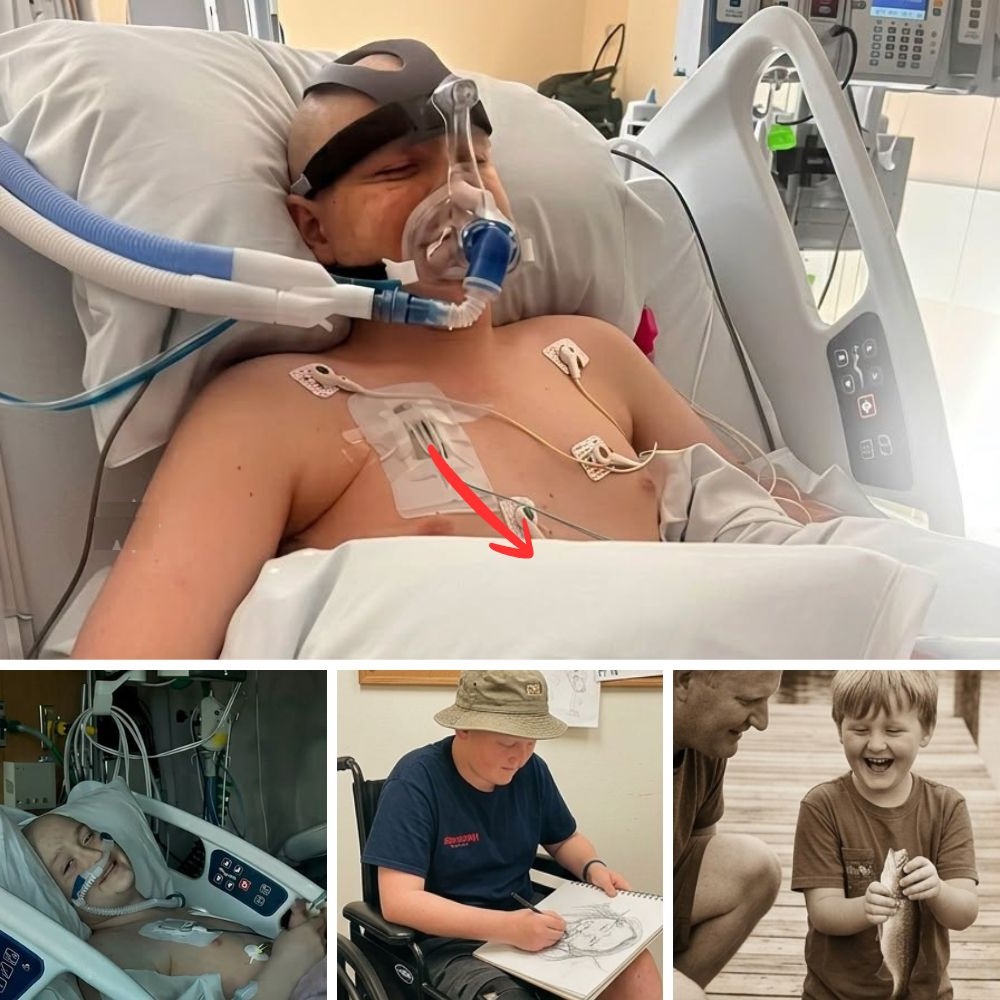
After months of hospital rooms, emergency scans, experimental treatments, sleepless nights, whispered prayers, and impossible medical decisions, her 15-year-old son, Will Roberts, took his final breath surrounded by the people who loved him most.
The room was quiet.
The lights had been dimmed.
Will’s family held his hands and spoke to him gently as the machines around his bed were gradually silenced.
Cancer had exhausted his body, but those closest to him believed it had never conquered the person inside it.
Will was more than a patient.
He was more than osteosarcoma.
He was the funniest person in the room when everyone else had forgotten how to laugh. He was the teenager who apologized to nurses after painful procedures, even when he had done nothing wrong. He was stubborn, mischievous, deeply loving, and determined to protect his family from the full weight of his fear.
And in the final hours of his life, his mother whispered the words she wanted him to carry with him.
“It was the greatest honor of my life to be your mama.”
The Birthday Brittney Never Wanted to Remember
Brittney had not planned to celebrate her birthday.
There had been messages from family members and friends, but she barely looked at them. A small paper bag containing a card and a cupcake sat untouched on the counter near the hospital window.
Her entire attention remained on Will.
His condition had deteriorated throughout the previous day.
His breathing became shallower. His heart rate fluctuated. Medication was adjusted repeatedly to control pain and anxiety. His kidneys and liver, already strained by months of treatment and disease, were no longer functioning well enough to support his body.
The medical team spoke gently but honestly.
They could continue monitoring him.
They could continue treating discomfort.
But they could no longer reverse what was happening.
Brittney had spent weeks fighting for every possible option.
She had asked for second opinions.
She had questioned test results.
She had challenged doctors whenever she feared decisions were being made too quickly.
She had prayed for a miracle bold enough to overturn every prediction.
But that morning, the meaning of fighting changed.
It was no longer about demanding another procedure.
It was about making sure Will was not afraid.
The Final Family Gathering
Will’s family gathered around the bed one person at a time.
No one knew what to say.
Some spoke about ordinary memories because the extraordinary pain was too difficult to face directly.
They reminded him of holidays at home.
They talked about Rocky and Rebel, the two dogs who still waited near the door whenever they heard a car outside.
They remembered the way Will complained about hospital food and then secretly ate the desserts.
They laughed through tears about his habit of pretending not to hear instructions whenever he wanted to avoid physical therapy.
Will could no longer answer clearly, but at times his expression seemed to change when familiar voices filled the room.
Jason stood near his son’s shoulder, one hand resting against the blanket.
He had spent months trying to remain strong for everyone else.
In those final hours, strength no longer meant hiding grief.
He leaned close and told Will how proud he was.
“You never had to prove anything to us,” he whispered. “You were enough every single day.”
More Than the Illness That Changed His Body
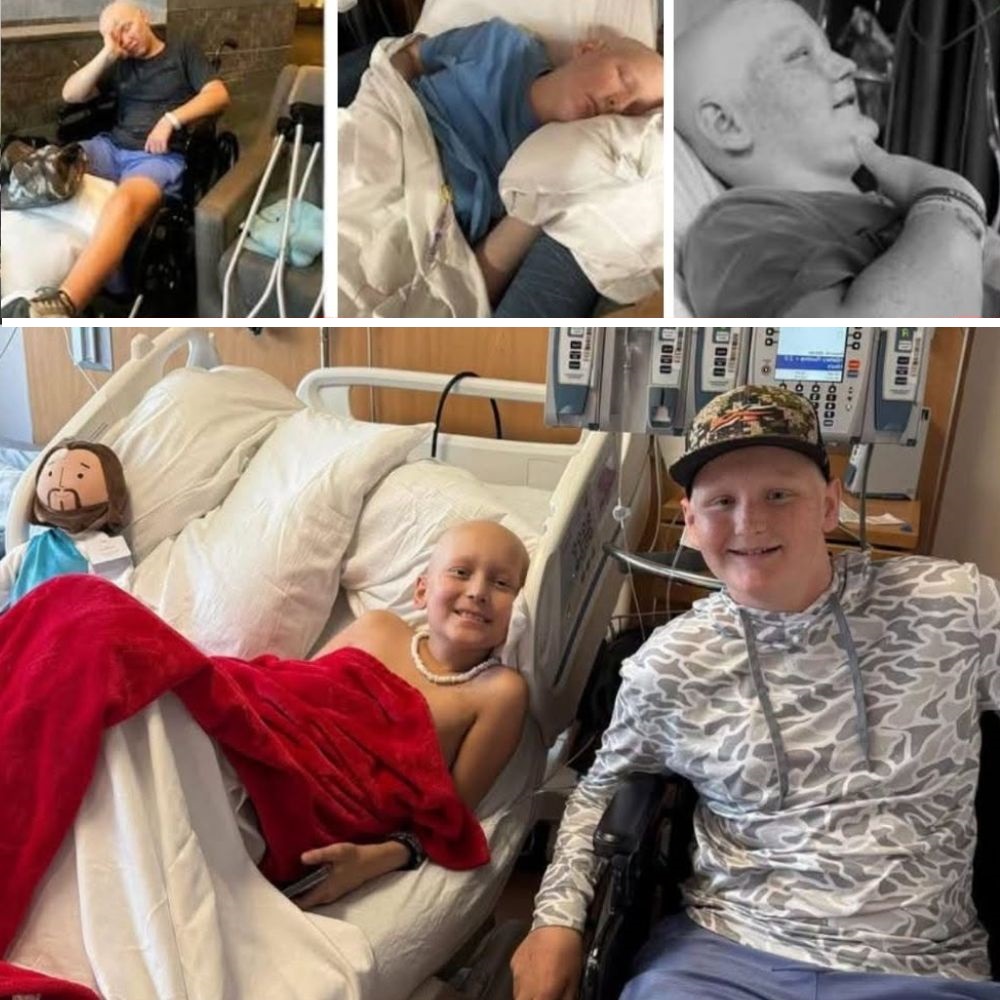
Osteosarcoma had altered Will’s life in ways few teenagers could imagine.
Treatment brought long hospital stays, nausea, infections, exhaustion, and relentless pain. Eventually, surgery required the loss of a limb, changing how he moved through the world and forcing him to rebuild skills that had once felt automatic.
People unfamiliar with Will’s story sometimes saw only the visible evidence of illness.
The wheelchair.
The prosthetic discussions.
The IV lines.
The missing hair.
The hospital photographs.
His family saw something else.
They saw the boy who learned how to make jokes about circumstances that would have broken many adults.
They saw him encourage younger patients even on days when he was suffering.
They saw him ask doctors direct questions because he wanted to understand his own treatment rather than disappear inside decisions made around him.
One nurse remembered entering his room after an especially difficult procedure.
Will looked exhausted.
His face was pale.
Yet when he noticed the nurse appeared upset, he asked whether she was okay.
“That was Will,” she later said. “He could be carrying more pain than anyone in the building and still notice somebody else’s sadness.”
The Moment the Room Changed
As evening approached, Will’s breathing changed.
The pauses between breaths became longer.
A nurse explained quietly that the family should remain close.
Brittney moved her chair directly beside the bed.
She placed one hand against Will’s cheek and the other around his fingers.
She had spent years holding that hand.
She held it when he learned to walk.
She held it crossing parking lots.
She held it before surgeries.
She held it through chemotherapy, scans, fevers, and nights when neither of them believed morning would arrive.
Now, she held it as his body began to let go.
“Will,” she said softly, “you don’t have to be brave for us anymore.”
The room filled with quiet sobbing.
“You have fought so hard. You have loved us so well. You can rest.”
She paused, struggling to continue.
Then she spoke the words that later became the center of the family’s farewell.
“It was the greatest honor of my life to be your mama.”
A Mother’s Final Promise
Brittney did not ask Will to stay.
That was one of the hardest choices she had ever made.
Every part of her wanted another minute.
Another breath.
Another chance to hear him say “Mom.”
But she also knew how tired he was.
She promised him that his story would not be reduced to the final months of suffering.
She promised that people would remember his humor.
His stubbornness.
His kindness.
His ability to make hospital staff laugh during the darkest moments.
She promised Rocky and Rebel would be cared for.
She promised the family would continue supporting children facing cancer.
Most of all, she promised Will that his name would still be spoken inside their home.
“You will always be my son,” she whispered. “Nothing can change that.”
When the Machines Became Quiet
There was no dramatic moment.
No sudden movement.
No final speech.
Will’s last breath came gently.
His family remained close.
The monitor slowed.
A nurse stood quietly near the doorway, giving them privacy while still making sure Will remained comfortable.
Then the room became still.
For several seconds, nobody moved.
Brittney continued holding her son’s hand.
The physician entered, completed the necessary examination, and confirmed what everyone already knew.
Will was gone.
But his mother did not release him immediately.
She rested her forehead beside his and cried without trying to hide the sound.
The birthday card remained unopened across the room.
The Journal Entry Written After Midnight
Hours later, after relatives had left and the hospital room had been cleared of most equipment, Brittney opened the journal she had kept throughout Will’s illness.
Some entries contained medication schedules.
Others held questions for doctors.
Many were prayers written at times when speaking aloud felt impossible.
That night, she wrote without editing herself.
She began:
“My beautiful boy left this world today, on the day I was born. For every birthday I have for the rest of my life, I will remember that it was also the day you were finally free from pain.”
She wrote about the cruelty of cancer.
She wrote about anger.
She admitted she did not understand why a child who loved life so deeply had been required to suffer so much.
Then the entry changed.
“I do not want the final image of you to be a hospital bed,” she wrote. “I want to remember your laugh. I want to remember you teasing your dad. I want to remember the way you smiled when a therapy dog entered your room.”
She continued:
“You were never cancer. Cancer was something that happened to you. It was never the most important thing about you.”
The Faith That Carried the Family
The Roberts family had often spoken openly about their Christian faith.
During the most difficult months, faith had not protected them from fear or anger.
There were nights when Brittney prayed confidently.
There were other nights when she could barely form words.
She sometimes questioned why healing had not come in the way they desperately wanted.
Yet in the final hours, the family found comfort in believing Will’s suffering had ended.
They imagined him stepping beyond the limitations of the body that had caused him so much pain.
No hospital bed.
No medication.
No wheelchair.
No fear.
Brittney wrote that she pictured Jesus meeting him with open arms.
Whether others shared that belief was not important to her.
It was the image that allowed her to breathe when grief felt physically unbearable.
“My son is not hurting,” she wrote. “I will repeat that until my heart begins to understand it.”
The Messages That Flooded In
News of Will’s passing spread quickly.
Messages came from across the country and beyond.
Families who had followed his treatment shared photographs of candles placed in windows.
Cancer survivors wrote about how Will’s determination had inspired them.
Nurses remembered his jokes.
Parents of seriously ill children thanked Brittney for speaking honestly about hope, fear, exhaustion, and the difficult realities of pediatric cancer.
Some people had never met Will.
Yet they felt they knew him through the updates his family had shared.
The stories were not always easy.
There had been setbacks, emergency decisions, painful procedures, and uncertain test results.
But there had also been moments of joy.
Eight hours spent out of bed.
A visit from a therapy Beagle.
A smile after days of silence.
A clear sentence spoken when doctors feared confusion had taken over.
Those moments became part of the farewell.
How the Family Plans to Honor Him
The Roberts family made it clear that Will’s legacy would not end with a funeral.
They announced plans to create a charitable initiative in his name.
The project would support families facing long-term pediatric cancer treatment, particularly those struggling with travel expenses, food, temporary housing, and pet care during extended hospital stays.
Brittney knew how much comfort Rocky and Rebel had brought Will.
She wanted part of the initiative to help families arrange therapy-animal visits and maintain connections with pets waiting at home.
The family also hoped to provide “Will’s Warrior Bags” for teenagers entering cancer treatment.
Each bag would include practical items rarely considered by people outside the hospital world: soft blankets, charging cables, comfortable clothing, notebooks, noise-canceling headphones, and gift cards for meals.
But the bags would also include something inspired by Will’s personality.
A small card encouraging patients to write down one thing that made them laugh that day.
“Will believed humor belonged in the hospital,” Jason explained. “Even when nothing was funny, he found something.”
A Different Kind of Bell
In many cancer centers, patients ring a bell when treatment ends.
Will never received the ending his family prayed for.
The disease took too much.
Still, Brittney wanted a bell included in his memorial.
Not as a symbol of treatment completed.
As a symbol of pain completed.
The family planned to invite nurses, therapists, friends, and fellow patients to ring it once in Will’s honor.
They imagined the sound carrying through the gathering, each ring representing a memory.
A joke.
A smile.
A moment of courage.
A life that mattered.
The Empty Place at Home
Returning home was almost impossible.
Rocky and Rebel ran toward the door when Brittney and Jason entered.
They searched behind them.
Rebel walked into Will’s bedroom and remained there.
Rocky rested near the empty bed.
The family did not remove Will’s belongings.
His shoes remained beside the wall.
A sweatshirt was still draped across a chair.
A half-finished drink sat on the desk until Brittney finally found the strength to move it.
Grief lived inside ordinary objects.
Not only photographs and memorial gifts.
A charger.
A blanket.
A favorite cup.
A door that would no longer open with his hand.
The Boy Behind the Warrior
Will was often called a warrior.
His family understood why.
He fought through pain and uncertainty with extraordinary determination.
But Brittney wanted people to remember that Will had never chosen the battle.
Children with cancer are often praised for bravery because adults need language strong enough to describe what they endure.
Yet Will was also allowed to be afraid.
He was allowed to be tired.
He was allowed to say he had reached his limit.
His courage did not come from never breaking down.
It came from remaining himself even when illness tried to take everything familiar away.
He remained funny.
He remained loving.
He remained Will.
The Final Lines of Brittney’s Letter
Brittney ended her journal entry shortly before dawn.
The last words were written directly to her son.
“I would have carried your pain for you if love had allowed it. I would have traded every birthday I had left for one more healthy year of your life.”
“But being your mother was never a burden. Not for one second. It was the greatest privilege, the greatest joy, and the greatest honor I will ever know.”
“I do not know how to live in a world where I cannot hear your voice. But I will learn because you taught me how to keep going when the next step feels impossible.”
“I love you beyond this life.”
A Legacy Larger Than Loss
Will Roberts’ story did not end as anyone wanted.
There was no last-minute cure.
No scan that overturned every prediction.
No treatment powerful enough to return him permanently to the life waiting outside the hospital.
But a life does not need a perfect ending to carry extraordinary meaning.
Will’s fifteen years changed the people around him.
He taught medical professionals that humor could survive beside suffering.
He showed strangers that illness never removes a person’s identity.
He reminded families to celebrate small victories because ordinary moments can become sacred without warning.
Most importantly, he taught his mother that love could remain even after the hand she held became still.
Every year, Brittney’s birthday will carry an ache that words cannot soften.
It will mark the day she received life and the day her son’s earthly life ended.
But it will also remind her of the sentence she whispered as he left.
“It was the greatest honor of my life to be your mama.”
Cancer may have ended Will’s life.
It did not erase his laughter.
It did not erase the love he gave.
And it could never erase the place he will hold in the family that promised to carry his name forward for as long as they live.
💔 STELLA PARTON BREAKS HER SILENCE — What She Said About Dolly’s Health Has Fans Looking Back
Dolly Parton’s Sister Breaks Silence What Really Happened - GMT - G1
Stella Parton was born May 4, 1949, the sixth of twelve children raised by Robert Lee and Avie Lee Parton in Sevierville, Tennessee — a household defined by noise, limited money, and almost no privacy, the kind of environment that produced strong, determined personalities.
Stella was one of them.
By seven, she was appearing alongside her older sister Dolly on a Knoxville television program; by her teens, she was writing her own songs, though marriage and motherhood pulled music to the margins of her life for a stretch.
The dream never fully disappeared.

In 1967, she recorded a gospel album with her mother and sisters, and later worked clubs in Washington, D.C., before founding her own record label in 1975 and releasing “I Want to Hold You in My Dreams Tonight,” which climbed to number nine on the country charts.
Long before any of that commercial success, Stella had already shown a willingness to take positions others avoided.
At 26, amid backlash against Australian singer Olivia Newton-John for winning recognition in country music, Stella recorded “Ode to Olivia” in her defense — a stand that offered her no career benefit and real risk of criticism, but one she took anyway simply because she believed staying silent was the wrong choice.
That instinct defined the rest of her career: hits like “The Danger of a Stranger” and “Steady as the Rain” (written by Dolly) built a genuine, independent following, including in the U.K., while Stella also worked in New York theater and spoke openly, often controversially, about poverty, domestic violence, and the treatment of women in the music industry.
She was named the Christian Country Music Association’s Female Vocalist of the Year in 2004.
Through all of it, she remained defined publicly, more often than not, as simply “Dolly’s little sister” — a label she spent five decades quietly proving didn’t tell the full story.
That same directness is why her comments in the fall of 2025 carried real weight.
Stella had never positioned herself as the family’s image manager or spokesperson; she was, by reputation, someone who believed difficult truths shouldn’t stay hidden indefinitely.
What she described wasn’t dramatic or accusatory — it was a portrait of a woman who had spent years prioritizing everyone else’s needs over her own.
The context mattered.
Carl Dean, Dolly’s husband of nearly sixty years, died in March 2025 at 82, after a long illness during which Dolly had devoted herself almost entirely to his care.
She later acknowledged that in the process, she’d neglected her own health significantly.
The loss reverberated through the whole extended family — the Partons had lost three brothers in the years surrounding this period, compounding grief that, for a family that had once crowded twelve children into a single small home, meant losing pieces of a shared childhood one after another.
Stella herself went seven years without releasing new music during this stretch, later describing the period simply as one shaped by sorrow, while still speaking about the importance of finding moments of laughter within it.
Looking back, one moment reads very differently in hindsight than it did at the time: in late September 2025, Dolly postponed her planned Las Vegas residency, citing health challenges — a rare cancellation for a performer whose six-decade career had included very few of them.
At the time, most fans treated it as a minor, temporary setback.
Stella’s later reflections suggested the signs had actually been building for some time, visible to family in ways the public smile made easy to miss.
That concern crystallized publicly not long after, when Dolly’s younger sister Frieda posted a simple request on Facebook asking fans to pray for Dolly.
What looked at first like an ordinary, well-meaning gesture spread rapidly, sparking widespread speculation about how serious Dolly’s condition actually was.
Dolly herself responded directly within days, appearing in a video from a Grand Ole Opry commercial shoot, insisting with her familiar humor that she wasn’t finished yet — the now widely remembered “I ain’t dead yet” moment that briefly quieted public concern.
In the months that followed, the pattern repeated: reassuring updates about kidney stones, dehydration, and treatment, paired with continued work on new projects, right up until Dolly Parton’s death on August 25, 2026, at 80.
Looking back across that full timeline — the postponed residency, the family’s public worry, Stella’s own account of a sister who consistently deprioritized her own wellbeing — it becomes easier to see what the people closest to Dolly understood well before the rest of the world did: that the warmth and resilience the public saw every time she appeared on camera came at a real, largely invisible cost.