THE TRUTH BEHIND THE THANCHANOK DONHOMLA CASE Australian truck driver’s chilling final hours with Thai teen whose naked body was dumped in a suitcase by the railway tracks
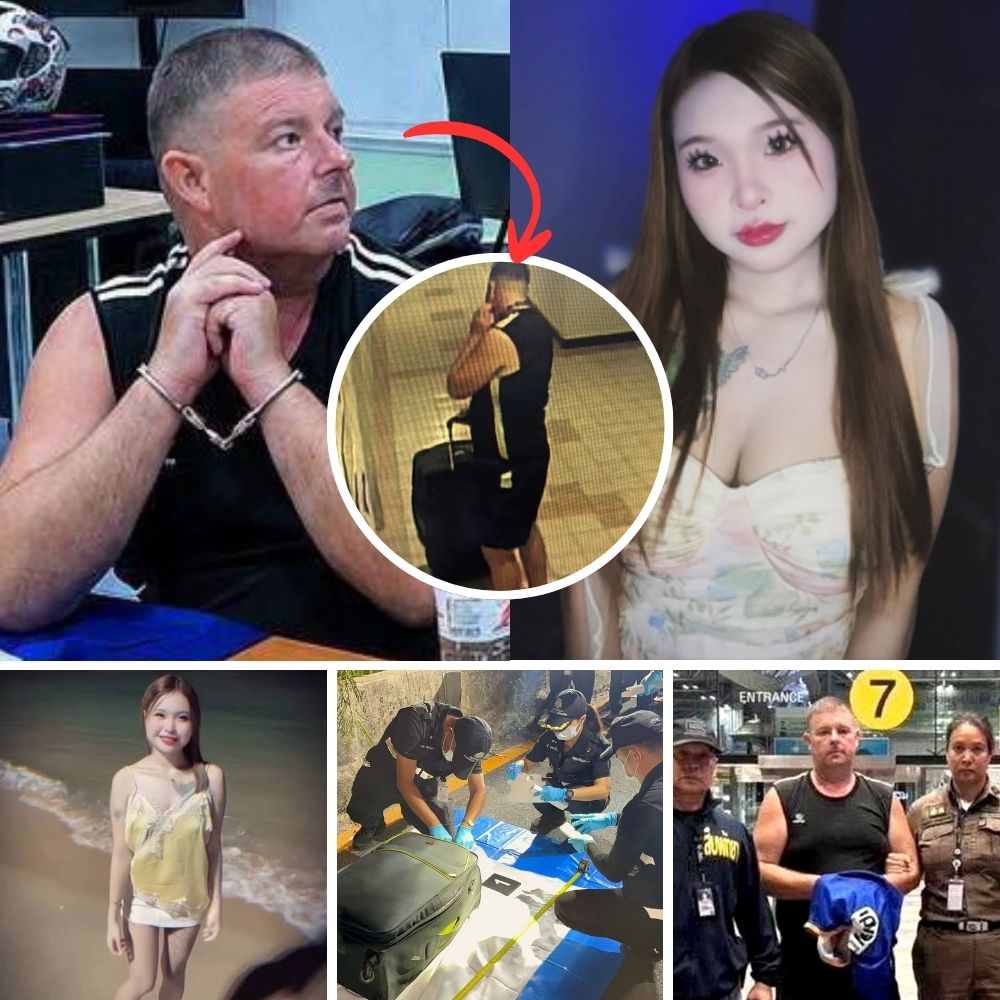
She was just 17. A quiet only child from a poor province in north-east Thailand who had promised her family she would bring home clothes for her baby cousin. Instead, Thanchanok Donhomla — known lovingly as “Cake” or “Nong Cake” — ended up naked, strangled and stuffed into a black suitcase that was discarded in the undergrowth beside a railway line in the notorious party town of Pattaya.
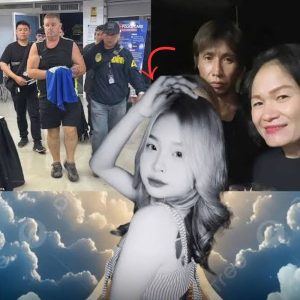
The man Thai police say is responsible is Simon Peter Carman, a 45-year-old former truck driver from Western Australia who was arrested at Bangkok’s Suvarnabhumi Airport as he prepared to board a Jetstar flight home to Perth. He has been charged with murder, concealing a corpse, and taking a minor for 𝘴єxual purposes. He denies murder and claims self-defence. Her family wants him executed.
What follows is the full, devastating timeline pieced together from police statements, CCTV, witness accounts and the anguished words of those who loved her.
A dutiful daughter with a hard life
Thanchanok grew up in Kalasin province, roughly 480 kilometres from the glittering, seedy beaches of Pattaya. Her mother left when she was young. She lived with her father Thongchai and stepmother, helping sell garlands and fruit at road intersections during Thai New Year. Friends and relatives describe a girl who “never showed sorrow about her difficult life,” who smiled through hardship and always found a way to help her father.
In mid-June 2026 she travelled to Pattaya for the first time, telling her parents she wanted a holiday with a friend. She had been in the resort city for about a week when she vanished.
Thanchanok Donhomla, 17, known to family and friends as “Cake.”
The night everything went wrong
In the early hours of Thursday 25 June, witnesses say Carman had been drinking on the Beach Road vice strip in Jomtien, the beachside area of Pattaya infamous for its sex tourism. He was reportedly rejected by one woman at a bar. Around 2am he encountered Thanchanok.
CCTV later released by police shows the pair entering a condominium building in Jomtien at 3.34am, walking hand-in-hand into a lift bound for the 15th floor. She was wearing jeans. He was in shorts and a black sleeveless T-shirt. They looked, to the camera, like any other couple heading upstairs in the small hours.
What happened next inside the rented flat is known only through Carman’s later statements to police and the forensic evidence.
According to investigators, an argument erupted over money. Carman had allegedly agreed to pay 1,000 baht (about £23 or A$43) for her company. When they returned to the room he offered only 500 baht. Police say he claimed the teenager produced a knife and held it to his throat. He is a large man — around 180cm and over 100kg. She was a slight 17-year-old.
He admitted strangling her until she lost consciousness. He said he did not intend to kill her. Autopsy results later confirmed the cause of dєatᩚh as strangulation. There were no serious wounds to her face or head, and none of her limbs were broken. Police noted fingernail scratches across Carman’s body consistent with a struggle. When asked about the marks on camera, he claimed they were from a spider.
He left her body in the bathroom for hours. Later he stuffed the naked corpse into a large black suitcase.
The suitcase on the motorcycle
At approximately 9.25pm on the same day — nearly 18 hours after the pair entered the building — CCTV captured Carman leaving the condo alone, hauling the heavy suitcase. He loaded it onto a motorcycle and rode towards the railway line. He returned without the bag at about 10pm.
The suitcase, containing Thanchanok’s body, was discovered in the early hours of Saturday near the tracks. Forensic officers in blue gloves measured and photographed the scene under portable lights.
Police examine the suitcase found near the railway line in Pattaya.
The friend who went looking
On the morning of Friday 26 June, a friend of Thanchanok reported her missing. The friend told police she had last seen the teenager with a foreign man. Security footage shows the friend arriving at Carman’s apartment later that afternoon. Images capture her speaking with him inside the flat. The mattress was stripped, clothes were in piles, dishes sat in the kitchen sink.
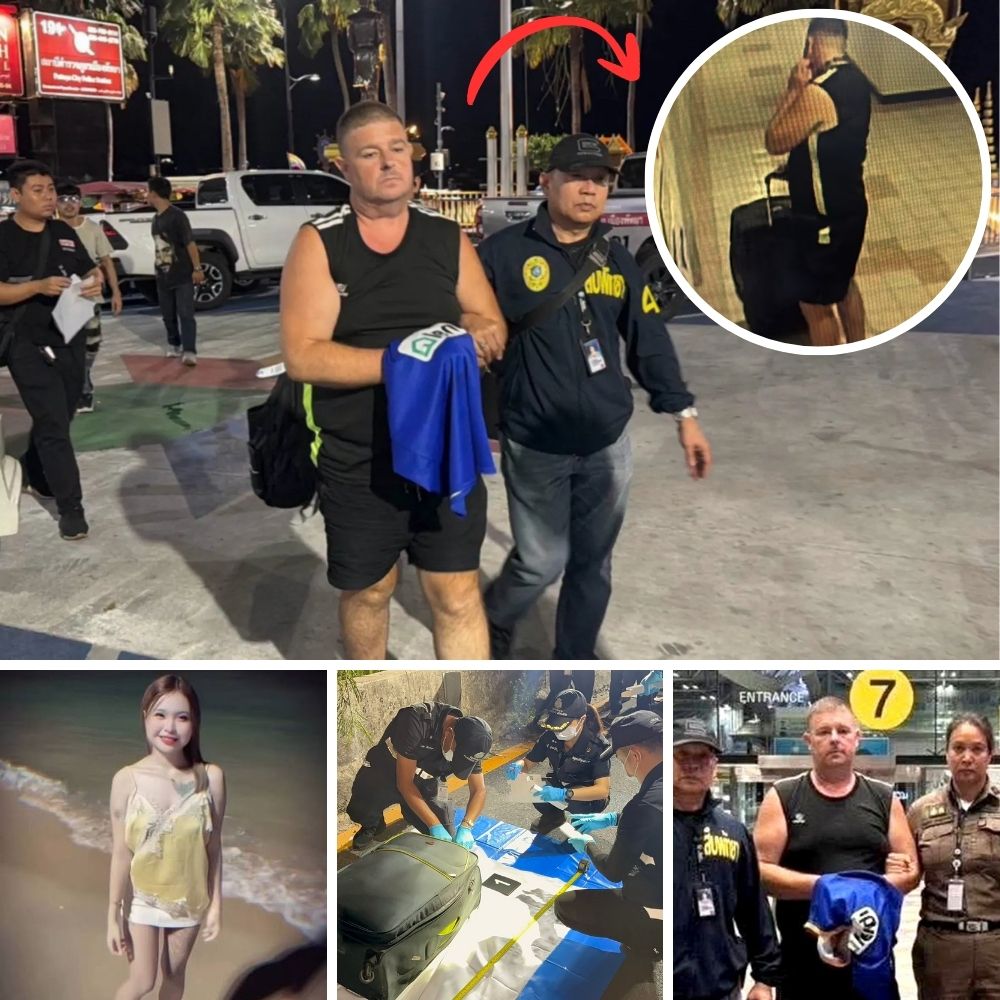
Carman left the condo again that afternoon. Police obtained an arrest warrant, found his passport in the room, and tracked him to Bangkok airport. He was stopped at 1.15am on Saturday, minutes before his flight.
“I know you’ll be very sad… same-same me”
Carman initially told police the girl had simply “disappeared from the room” while he slept. Confronted with the CCTV, he changed his story and admitted the strangling, insisting it was self-defence after she threatened him with a knife over the disputed payment.
In a bizarre recorded message later released, he addressed Thanchanok’s parents: “I know you’ll be very sad, upset, same-same me. It shouldn’t happen and I hope you’re okay.” He said the dєatᩚh was “out of my control.”
Thai police have charged him with murder, concealing a body in an attempt to hide the cause of dєatᩚh, and offences related to taking a minor aged 15 to 18 for indecent purposes (consent is irrelevant under the law). He remains in Pattaya Remand Prison. No trial date has been set. If convicted of murder he faces the dєatᩚh penalty — a sentence the victim’s family is openly demanding.
“I want him executed”
Thanchanok’s father Thongchai and other relatives travelled nearly 600 kilometres from Kalasin to Pattaya. Outside the police station they called for the maximum punishment. They have rejected any suggestion of compensation from the accused. “I don’t know what else to say,” one family member said. “I want him executed.”
The body was released after the autopsy in Bangkok. A traditional funeral ritual was held in her hometown to give her a peaceful afterlife. Relatives described a much-loved, dutiful teenager who had simply wanted to help her family and enjoy a short break by the sea.
Simon Peter Carman in police custody after his arrest.
Pattaya’s dark underbelly
The killing has sent a chill through the bars and beaches of Pattaya and Jomtien. The town has long thrived on sex tourism, much of it involving young Thai women and older foreign men. Local sex workers have spoken of increased fear. One told reporters the industry is “funded by anonymous male tourists” who often treat the women as disposable.
Carman had been living in Pattaya for some time, having returned late last year. Those who knew him in Australia described a man who had become increasingly isolated from friends and family over the past decade. Neighbours in Jomtien said they had not heard of previous violence, though some noted he became irritated by drunken behaviour around the condo.
Police have examined the apartment thoroughly. Photos taken after the disappearance show a stripped mattress and a lived-in, somewhat squalid space. No knife was publicly confirmed as recovered, though Carman claimed one was used against him.
A life reduced to a suitcase
In the days after the discovery, coverage focused heavily on the grotesque method of disposal — the suitcase by the railway. Some commentators, both in Thailand and abroad, pushed back hard. “Thanchanok Donhomla is not a ‘body in a suitcase’,” one Australian post declared. “She was a human being with a family, friends and a community now grieving.”
She was an only child who sold flowers at traffic lights to help her father. She promised to bring home clothes for a baby cousin. She smiled through a tough life. She was 17 years old.
Simon Peter Carman insists the dєatᩚh was never meant to happen. Thai prosecutors and the girl’s family insist the evidence tells a different story: a grown man, a minor, an argument over a few hundred baht, a strangling, a suitcase, and a desperate attempt to flee the country before the body was found.
The legal process in Thailand will now decide whether that sequence amounts to murder or the self-defence he claims. For Thanchanok’s father, standing outside a police station hundreds of kilometres from home, the answer is already clear.
He wants the man who took his daughter executed.
The suitcase has been examined. The body has been returned. The CCTV has been released. The charges have been laid. And a 17-year-old girl who only wanted to bring clothes home for a baby will never walk off a plane in Kalasin again.
That is the truth behind the Thanchanok Donhomla case — as far as the evidence so far allows us to see it.
💔 STELLA PARTON BREAKS HER SILENCE — What She Said About Dolly’s Health Has Fans Looking Back
Dolly Parton’s Sister Breaks Silence What Really Happened - GMT - G1
Stella Parton was born May 4, 1949, the sixth of twelve children raised by Robert Lee and Avie Lee Parton in Sevierville, Tennessee — a household defined by noise, limited money, and almost no privacy, the kind of environment that produced strong, determined personalities.
Stella was one of them.
By seven, she was appearing alongside her older sister Dolly on a Knoxville television program; by her teens, she was writing her own songs, though marriage and motherhood pulled music to the margins of her life for a stretch.
The dream never fully disappeared.

In 1967, she recorded a gospel album with her mother and sisters, and later worked clubs in Washington, D.C., before founding her own record label in 1975 and releasing “I Want to Hold You in My Dreams Tonight,” which climbed to number nine on the country charts.
Long before any of that commercial success, Stella had already shown a willingness to take positions others avoided.
At 26, amid backlash against Australian singer Olivia Newton-John for winning recognition in country music, Stella recorded “Ode to Olivia” in her defense — a stand that offered her no career benefit and real risk of criticism, but one she took anyway simply because she believed staying silent was the wrong choice.
That instinct defined the rest of her career: hits like “The Danger of a Stranger” and “Steady as the Rain” (written by Dolly) built a genuine, independent following, including in the U.K., while Stella also worked in New York theater and spoke openly, often controversially, about poverty, domestic violence, and the treatment of women in the music industry.
She was named the Christian Country Music Association’s Female Vocalist of the Year in 2004.
Through all of it, she remained defined publicly, more often than not, as simply “Dolly’s little sister” — a label she spent five decades quietly proving didn’t tell the full story.
That same directness is why her comments in the fall of 2025 carried real weight.
Stella had never positioned herself as the family’s image manager or spokesperson; she was, by reputation, someone who believed difficult truths shouldn’t stay hidden indefinitely.
What she described wasn’t dramatic or accusatory — it was a portrait of a woman who had spent years prioritizing everyone else’s needs over her own.
The context mattered.
Carl Dean, Dolly’s husband of nearly sixty years, died in March 2025 at 82, after a long illness during which Dolly had devoted herself almost entirely to his care.
She later acknowledged that in the process, she’d neglected her own health significantly.
The loss reverberated through the whole extended family — the Partons had lost three brothers in the years surrounding this period, compounding grief that, for a family that had once crowded twelve children into a single small home, meant losing pieces of a shared childhood one after another.
Stella herself went seven years without releasing new music during this stretch, later describing the period simply as one shaped by sorrow, while still speaking about the importance of finding moments of laughter within it.
Looking back, one moment reads very differently in hindsight than it did at the time: in late September 2025, Dolly postponed her planned Las Vegas residency, citing health challenges — a rare cancellation for a performer whose six-decade career had included very few of them.
At the time, most fans treated it as a minor, temporary setback.
Stella’s later reflections suggested the signs had actually been building for some time, visible to family in ways the public smile made easy to miss.
That concern crystallized publicly not long after, when Dolly’s younger sister Frieda posted a simple request on Facebook asking fans to pray for Dolly.
What looked at first like an ordinary, well-meaning gesture spread rapidly, sparking widespread speculation about how serious Dolly’s condition actually was.
Dolly herself responded directly within days, appearing in a video from a Grand Ole Opry commercial shoot, insisting with her familiar humor that she wasn’t finished yet — the now widely remembered “I ain’t dead yet” moment that briefly quieted public concern.
In the months that followed, the pattern repeated: reassuring updates about kidney stones, dehydration, and treatment, paired with continued work on new projects, right up until Dolly Parton’s death on August 25, 2026, at 80.
Looking back across that full timeline — the postponed residency, the family’s public worry, Stella’s own account of a sister who consistently deprioritized her own wellbeing — it becomes easier to see what the people closest to Dolly understood well before the rest of the world did: that the warmth and resilience the public saw every time she appeared on camera came at a real, largely invisible cost.