
She had spent so long learning how to fight for her daughter that, eventually, she realized she needed someone to help her learn how to breathe again.
So she picked up the phone.
After a particularly difficult emotional day, Eleanor’s mother began calling therapists, hoping someone would have an opening. She left voicemail after voicemail, reaching out to roughly five different people.
Then one therapist answered.
What happened next would become the first of several moments the mother now describes as one of her little “God winks.”
While looking at her calendar, the therapist asked an unexpected question: Would she be comfortable having the consultation right then?
The answer was immediate.
Yes.
The therapist explained that she had unexpectedly finished a hair appointment early that morning and happened to have about 15 minutes before her next client. She said that almost never happened.
But on that particular day, those 15 minutes were available.
And on that particular day, Eleanor’s mother desperately needed someone to talk to.
Maybe it was coincidence.
Maybe it was simply an unusually lucky opening in a busy schedule.
But for a mother who had spent months navigating fear, hospital rooms and uncertainty surrounding her little girl, it felt like something more.
She called it a “God wink.”
During those 15 minutes, she tried to fit as much of her story as possible into the conversation. There was so much to explain that, before hanging up, she even found herself asking the therapist whether she was sure she wanted to take all of it on.
The therapist reassured her.
She could handle it.
So, a little over a week later, the mother walked into the therapist’s office for her first full session.
And then she saw the number on the door.
Her birthday is January 4.
She knew how it sounded.
She knew a room number was just a room number.
But after everything that had happened, she decided she was keeping this one too.
Another little God wink.
And the session itself became just as meaningful.
She talked.
A lot.
At one point, she became so concerned that she had placed too much emotional weight on the therapist that she interrupted her own therapy session to ask, “Are you okay?”
The therapist reportedly looked at her as though she had lost her mind.
The mother explained that she had just shared so much and needed to make sure the therapist was all right.
Instead of being overwhelmed, the therapist laughed and reassured her that she was not going to overwhelm her.
For a woman who had spent so much time trying to protect everyone around her from the weight of her family’s experience, those words mattered.
She finally felt like she did not have to edit her story.
She did not have to make it easier for someone else to hear.
She could simply talk.
And, perhaps most importantly, she felt safe.
Before leaving, the two hugged.
But Eleanor was still very much at the center of the conversation.
During the session, her mother showed the therapist photographs of her children, including one particular picture of Eleanor.
It was a photograph she had shared before.
But to her mother, there was something about it that still stopped her in her tracks.
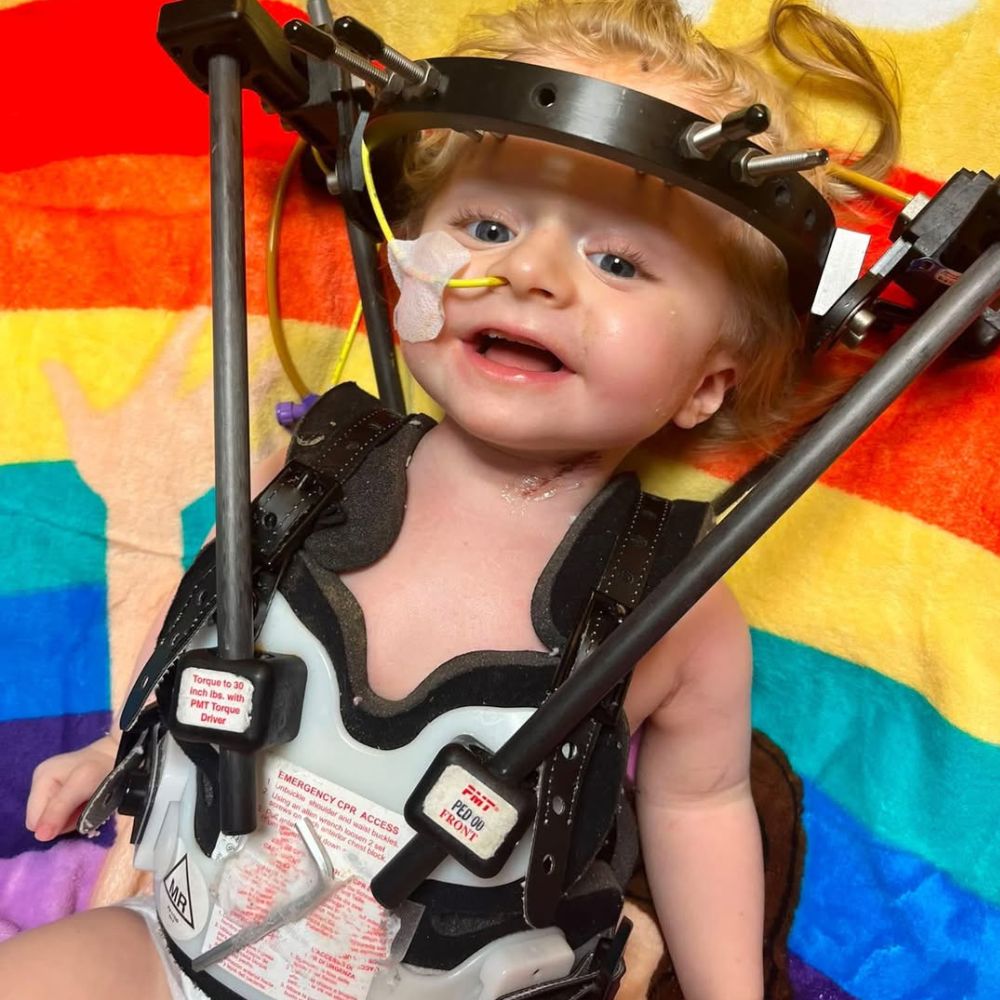
Eleanor, wearing her halo, looked like pure sunshine.
The picture had been taken nearly two months earlier in the hospital.
Since then, so much had changed.
Today, according to her mother, Eleanor is healing. She is not in pain. She is sitting up, playing with her sister, laughing, learning new things and enjoying the ordinary experiences of being a little girl.
She does not know when her halo will come off.
She does not understand medical timelines, follow-up appointments or the anxiety that can come with waiting for the next update.
She simply wakes up each morning and finds something worth smiling about.
And her mother says that, somewhere along this difficult journey, her two-year-old daughter taught her how to do the same.
The experience has changed the way she sees ordinary moments.
A peaceful car ride.
A new skill during physical therapy.
Two sisters playing together.
The sound of Eleanor laughing from her bedroom.
An unexpected 15 minutes with the exact person she needed to speak with.
And, of course, Room 104.
For Eleanor’s family, the little moments have become much bigger than they once seemed.
So has the support surrounding them.
Her mother says she still struggles to comprehend the number of people who have prayed for her daughter—people who have never met Eleanor but remember her name around dinner tables, in Bible study groups and at church.
Some light candles.
Some attend Mass and pray for her.
Others send messages, cards, meals or donations.
Some simply show up in the comments whenever Eleanor’s mother admits that she is struggling.
There are now more than 33,000 people following their journey.
They have seen the good days and the frightening ones. They have witnessed hospital updates, tears, setbacks and moments when Eleanor’s mother has admitted she was not sure how much more she could take.
And when she sounds like she is losing her footing, she says the response is often immediate.
People remind her to lift her head.
They tell her they are praying.
They tell her to keep going.
And somehow, she does.
After everything her family has experienced, she says she has learned that the world is not defined only by the painful things that make headlines.
There is still enormous goodness in people.
She has seen it through prayers, handwritten cards, meals, donations, candles, hugs and strangers who simply remembered her daughter’s name.
She has felt supported by people she may never meet in person.
And she has begun to understand that faith does not necessarily mean pretending everything is easy.
She is still working through anxiety.
After spending so much time in a hospital with her child, she says her mind and body are still learning that they do not have to remain on high alert every second.
That is why she walked into Room 104.
Not because her faith had disappeared.
But because she believes faith and therapy can exist together.
She can trust God completely and still accept the help placed in front of her.
That realization may be one of the most important lessons of Eleanor’s journey.
The experience has changed the way her mother moves through life.
She notices more.
She slows down.
She celebrates things that once might have seemed insignificant.
She listens to other people’s stories differently.
She accepts love differently.
And she says she loves differently, too.
Through sharing her family’s story, she has been entrusted with pieces of countless other people’s lives. She remembers their stories, wonders how they are doing and prays for them.
Perhaps that is why the little signs mean so much.
The unexpected phone call.
The 15 minutes.
Room 104.
A child’s laughter coming from the bedroom.
A community of strangers refusing to stop praying.
None of those moments can erase what this family has endured.
But together, they have become reminders that even in the hardest seasons, there can still be reasons to look up.
And perhaps that is what Eleanor has been teaching her mother all along.
If a little girl can wake up every morning carrying something so difficult and still find a reason to smile, then her mother can keep searching for reasons to smile too.
For this family, the miracles are not always loud.
Sometimes they look like healing.
Sometimes they sound like laughter.
And sometimes, they look like a therapist unexpectedly answering the phone—or a simple number on a door.
Just a room number.
Or, to one mother, one more tiny reminder to keep going.