THE “HOUSE OF HORRORS” VINTON COUNTY CRISIS: SURVIVORS’ RAGE AND THE OUTRAGE OVER SYMPATHY FOR ELIZABETH SIDERS
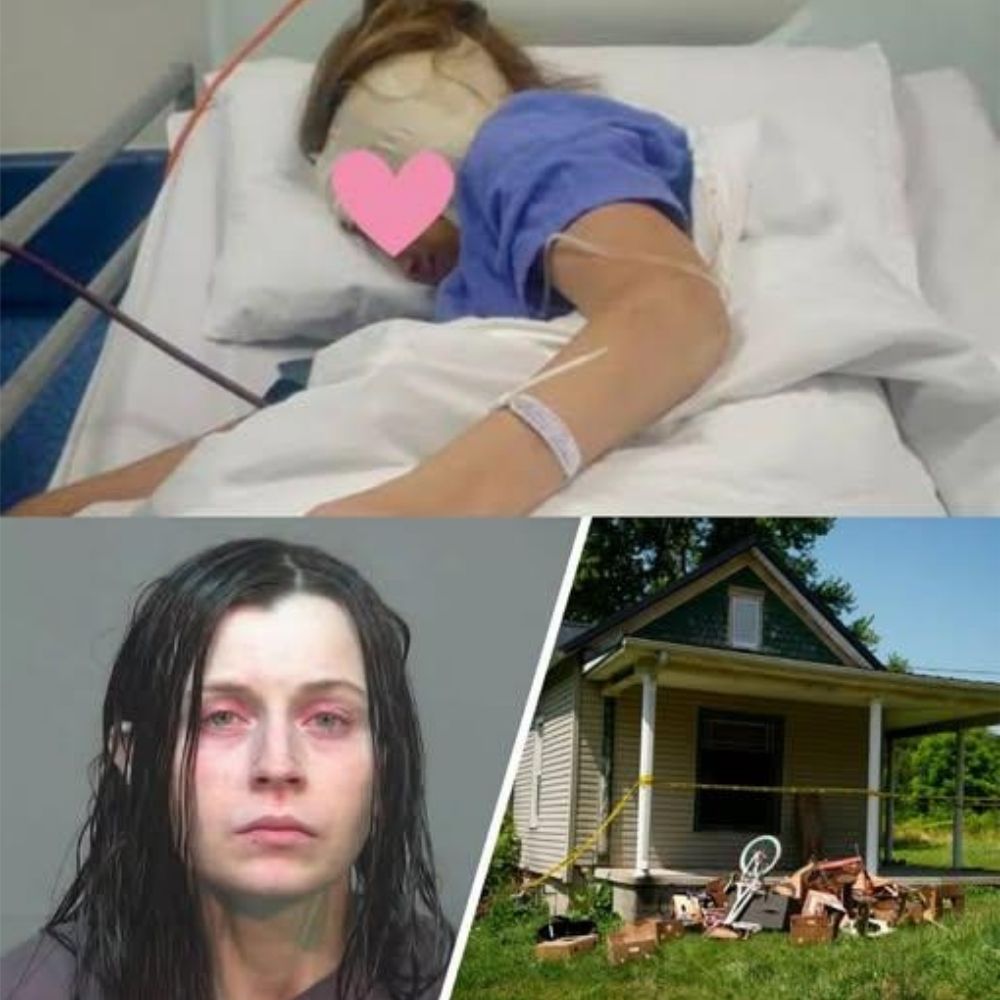
They were once hidden away from the world in a stifling, windowless room measuring less than 130 square feet, surrounded by mountains of trash, human waste, and swarms of insects. Now, from sterile hospital beds across Ohio, the young survivors of the Vinton County “house of horrors” are speaking out in absolute, unadulterated fury.
Outrage has erupted across legal circles and social media platforms after the defense team attempted to paint Elizabeth Siders—the 33-year-old mother facing a battery of horrific charges—as a “helpless child-bride” and a victim herself, deserving of sympathy rather than condemnation.
But the children, bearing deep physical and psychological scars, are refusing to let the narrative be rewritten.
“You feel sorry for her?! Who did this to our lives? Who is going to feel sorry for us?” one survivor cried out from a recovery ward. “She dumped every single ounce of her life’s resentment onto innocent children like us!”
FROM A 12-SQUARE-METER DUNGEON TO HOSPITAL LIGHTS
The case that has rocked the state of Ohio first began to unravel in late June 2026, when local law enforcement in the village of Hamden, Vinton County, executed a search warrant as part of an unrelated investigation. Officers were utterly unprepared for the nightmare waiting behind the doors of a dilapidated, rotting farmhouse whose floors practically caved beneath their boots.
Inside the claustrophobic space, authorities discovered a staggering 16 children ranging from toddlers (20 months old) to 18-year-olds. All of them were suffocating in squalor, coated in filth, and bitten by insects. Many had to be rushed to top-tier regional hospitals, with several requiring intubation and intensive emergency care.
The investigation soon uncovered a chilling reality: Elizabeth Siders was the biological mother to all 16 children. For nearly two decades, she had given birth almost annually while the household systematically isolated the victims from the outside world—denying them birth certificates, medical care, and even a single day of formal education.
“VICTIM” OR ARCHITECT OF ATROCITY?
In the Vinton County courtroom, as legal proceedings accelerated, defense attorney Thomas Stolly introduced a deeply controversial perspective.
Stolly revealed that Elizabeth married Gary Siders Jr. back in 2008 when she was just 15 years old and he was 18 in West Virginia—a state that permitted underage marriage at the time with parental consent. The defense attorney posed a provocative question to the public: Was his client, in fact, an initial victim of extreme familial control and grooming?
“When I walked into the jail cell to meet her, her first question wasn’t, ‘When can I get out?’ It was, ‘Are my children okay? Where are they?’” defense attorney Stolly told reporters.
However, this defense strategy triggered fierce backlash from the public and prosecutors alike.
Ohio Attorney General Andy Wilson firmly rejected any attempts to soften the narrative, telling the press: “What our investigators witnessed inside that home is the manifestation of pure evil. The conditions those children were forced to endure are utterly barbaric, and we remain haunted by what they suffered.”
A BITTER RECKONING: FIGHTING FOR JUSTICE
For neighbors living quietly around the Hamden area, the revelations feel like a lightning bolt. For years, no one suspected or caught a glimpse of the 16 children effectively erased from society’s view. The quiet, unassuming farmhouse nestled in the rural countryside had functioned as a prison camp for an entire generation.
Alongside Elizabeth Siders, three other family members—Gary Siders Jr. (husband), Gary Siders Sr. (father-in-law/grandfather), and Christina Siders (mother-in-law/grandmother)—have been arrested and face severe child endangerment charges. The impending hearings and potential sentences are drawing intense national scrutiny, exposing dangerous legal blind spots surrounding child marriage, domestic 𝘢bu𝘴e, and rural child welfare systems.
For the young survivors, while the physical and emotional road to healing stretches out endlessly before them, their opening words have rung clear across America: No amount of historical context or marital background can ever wash away the cruelty of abandonment and torture inflicted by the very people who brought them into the world.
💔 STELLA PARTON BREAKS HER SILENCE — What She Said About Dolly’s Health Has Fans Looking Back
Dolly Parton’s Sister Breaks Silence What Really Happened - GMT - G1
Stella Parton was born May 4, 1949, the sixth of twelve children raised by Robert Lee and Avie Lee Parton in Sevierville, Tennessee — a household defined by noise, limited money, and almost no privacy, the kind of environment that produced strong, determined personalities.
Stella was one of them.
By seven, she was appearing alongside her older sister Dolly on a Knoxville television program; by her teens, she was writing her own songs, though marriage and motherhood pulled music to the margins of her life for a stretch.
The dream never fully disappeared.

In 1967, she recorded a gospel album with her mother and sisters, and later worked clubs in Washington, D.C., before founding her own record label in 1975 and releasing “I Want to Hold You in My Dreams Tonight,” which climbed to number nine on the country charts.
Long before any of that commercial success, Stella had already shown a willingness to take positions others avoided.
At 26, amid backlash against Australian singer Olivia Newton-John for winning recognition in country music, Stella recorded “Ode to Olivia” in her defense — a stand that offered her no career benefit and real risk of criticism, but one she took anyway simply because she believed staying silent was the wrong choice.
That instinct defined the rest of her career: hits like “The Danger of a Stranger” and “Steady as the Rain” (written by Dolly) built a genuine, independent following, including in the U.K., while Stella also worked in New York theater and spoke openly, often controversially, about poverty, domestic violence, and the treatment of women in the music industry.
She was named the Christian Country Music Association’s Female Vocalist of the Year in 2004.
Through all of it, she remained defined publicly, more often than not, as simply “Dolly’s little sister” — a label she spent five decades quietly proving didn’t tell the full story.
That same directness is why her comments in the fall of 2025 carried real weight.
Stella had never positioned herself as the family’s image manager or spokesperson; she was, by reputation, someone who believed difficult truths shouldn’t stay hidden indefinitely.
What she described wasn’t dramatic or accusatory — it was a portrait of a woman who had spent years prioritizing everyone else’s needs over her own.
The context mattered.
Carl Dean, Dolly’s husband of nearly sixty years, died in March 2025 at 82, after a long illness during which Dolly had devoted herself almost entirely to his care.
She later acknowledged that in the process, she’d neglected her own health significantly.
The loss reverberated through the whole extended family — the Partons had lost three brothers in the years surrounding this period, compounding grief that, for a family that had once crowded twelve children into a single small home, meant losing pieces of a shared childhood one after another.
Stella herself went seven years without releasing new music during this stretch, later describing the period simply as one shaped by sorrow, while still speaking about the importance of finding moments of laughter within it.
Looking back, one moment reads very differently in hindsight than it did at the time: in late September 2025, Dolly postponed her planned Las Vegas residency, citing health challenges — a rare cancellation for a performer whose six-decade career had included very few of them.
At the time, most fans treated it as a minor, temporary setback.
Stella’s later reflections suggested the signs had actually been building for some time, visible to family in ways the public smile made easy to miss.
That concern crystallized publicly not long after, when Dolly’s younger sister Frieda posted a simple request on Facebook asking fans to pray for Dolly.
What looked at first like an ordinary, well-meaning gesture spread rapidly, sparking widespread speculation about how serious Dolly’s condition actually was.
Dolly herself responded directly within days, appearing in a video from a Grand Ole Opry commercial shoot, insisting with her familiar humor that she wasn’t finished yet — the now widely remembered “I ain’t dead yet” moment that briefly quieted public concern.
In the months that followed, the pattern repeated: reassuring updates about kidney stones, dehydration, and treatment, paired with continued work on new projects, right up until Dolly Parton’s death on August 25, 2026, at 80.
Looking back across that full timeline — the postponed residency, the family’s public worry, Stella’s own account of a sister who consistently deprioritized her own wellbeing — it becomes easier to see what the people closest to Dolly understood well before the rest of the world did: that the warmth and resilience the public saw every time she appeared on camera came at a real, largely invisible cost.